JAIIB case-study questions: how the case-based pattern works — and one free case to try right here
By Swarnakshi Jha (ex-banker) · 3 September 2026 · JAIIB Nov-2026 cycle · 7-minute read
Most JAIIB questions test one fact each. The ones candidates fear are different: a short story about a customer or a branch, followed by four or five questions that all depend on it. Since the 2023 syllabus revision, IIBF describes its papers as testing knowledge, conceptual grasp, analysis, problem-solving and case analysis — and case-based sets have become a regular feature of the PPB and IE&IFS papers, with numerical cases in AFM and product cases in RBWM. If you have only ever practised single MCQs, a case set costs you time, and time is the one thing the 72-second-per-question pace does not forgive.
So we built a Case Studies tab into the SJA Mock Centre: 80 cases, 20 per subject, 400 linked questions, each written from the audited unit notes and updated to the September 2026 position of the law (RB-IOS 2026, the ₹1-crore limit on loans against shares, the new MSME thresholds, the 2025 Income-tax Act, and so on). Below: how the pattern works, how to attempt it, and a complete PPB case you can answer on this page.
What a case-based set looks like
The scenario120–220 words: a customer, a transaction, some numbers and a complication. Everything you need is inside it — the questions do not add new facts.
Five linked questionsEach pulls a different rule out of the same story: classify, compute, decide, and then apply an exception. Read the case once, properly, and the five questions become fast.
Two positions where the law movedWhere the textbook and current law differ, the explanation gives both and tells you which the paper is likely to want.
Every option explainedWhy the answer is right and why each distractor is wrong — the distractors are the textbook's own trap-pairs, so the explanations are the revision.
How the tab works
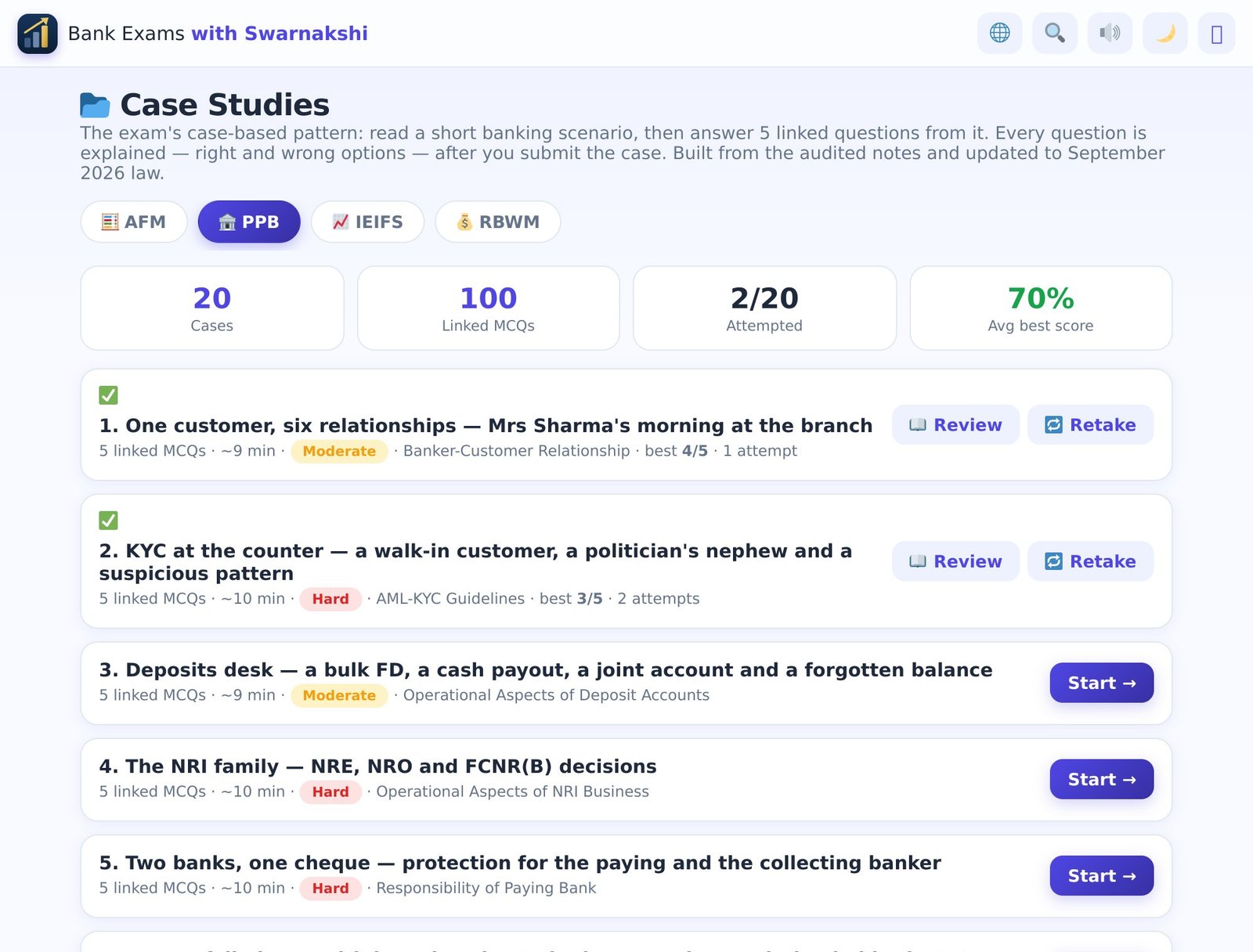
Home → Case Studies → pick a subject. Each row shows the linked-question count, the time target, difficulty and the unit the case is built on; attempted cases show your best score and a Review button.
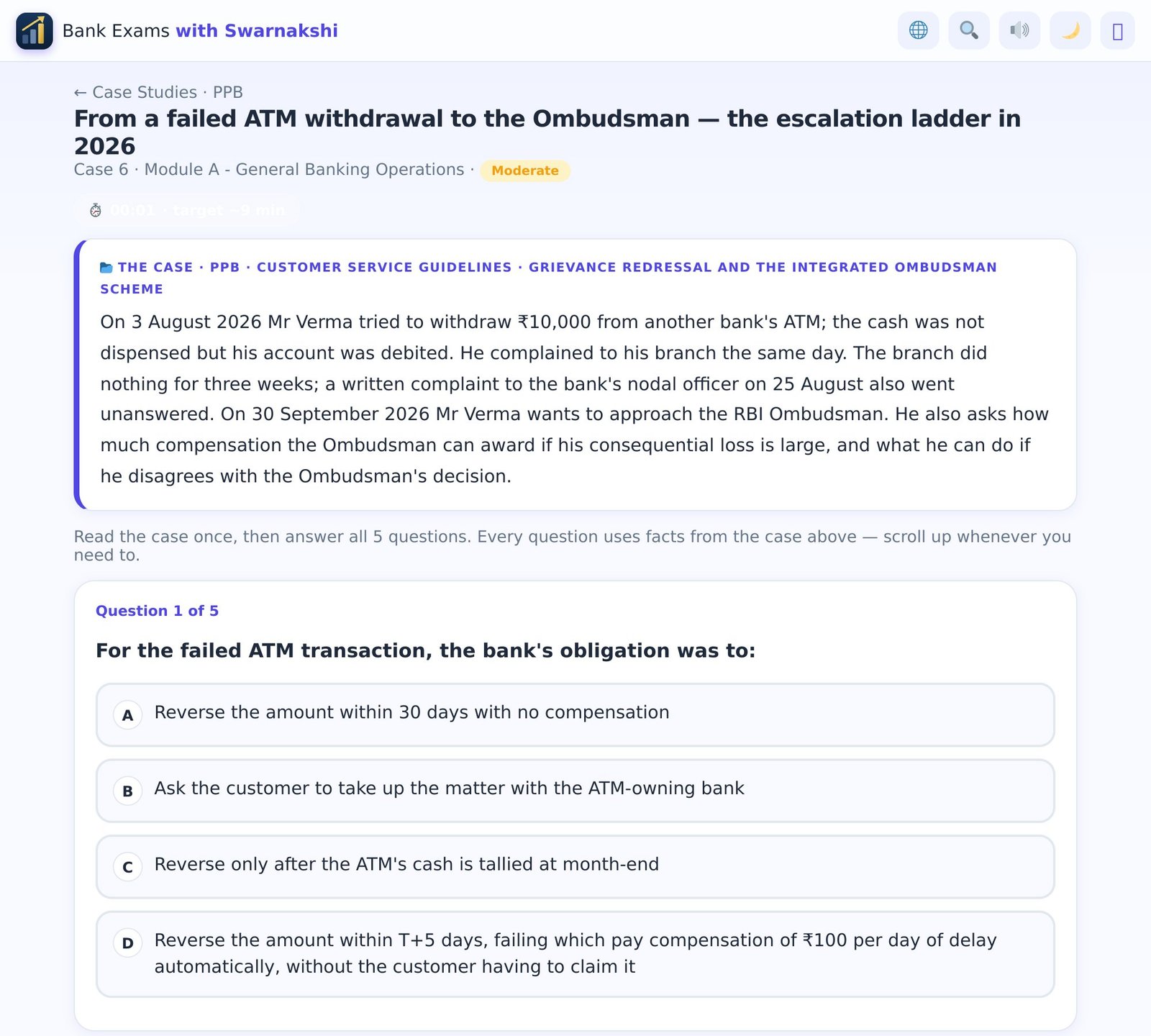
Open a case. The scenario sits at the top with the unit it is drawn from. A timer runs with a target (about 9 minutes for five questions — a little slower than the exam pace, because reading the case is part of the work).
Answer all five, then submit. Unlike unit mocks, nothing is revealed until you submit the whole case — exactly like the paper, where you cannot check question 1 before answering question 2. A sticky “Re-read the case” button takes you back up whenever you need a figure.
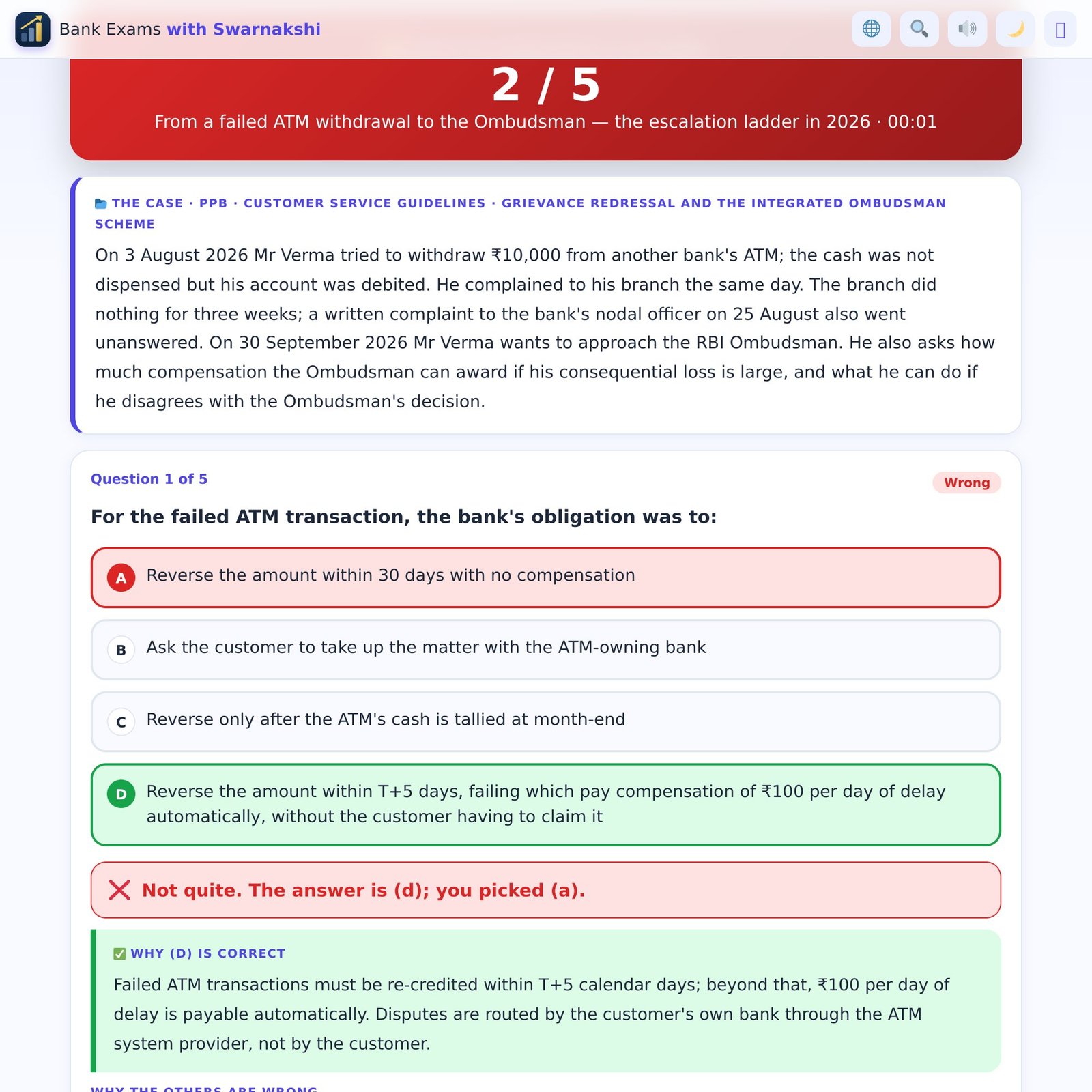
Read the verdicts. Every question turns green or red, with the why-right and why-wrong explanations underneath. Your score is stored; retakes reshuffle nothing (the case is the case), so the second attempt tests whether you learned the rule, not whether you remembered position C.
Watch the hub. The subject header shows how many cases you have attempted and your average best score. Case attempts also count towards your streak, XP and analytics — but not towards the Readiness Score's mock component, which stays reserved for full-length tests.
The case stays in view above the questions. The free demo opens the five AFM Module A cases; all 80 are part of every Mock Centre pass.After submitting: the score, then each question with the correct option, your pick, and the full explanation.
Try one now — a PPB case on consumer protection
This is case 7 of the PPB set, exactly as it appears in the Mock Centre. Read the scenario, answer each question, and the explanation opens the moment you choose.
📂 Free sample · PPB · A borrower goes to the consumer commission — jurisdiction, limitation and what counts as deficiency
Mrs Iyer took a home loan of ₹60 lakh in 2022. In March 2024 the bank wrongly dishonoured her cheque of ₹2 lakh (a housing-society payment) despite adequate balance, and in 2025 it delayed returning her title deeds for four months after she closed the loan. In July 2026 she wants to file a consumer complaint claiming ₹8 lakh as compensation. She also wants to complain that the bank refused to reduce her interest rate when a competitor offered a lower one, and her friend, a guarantor to a business loan, wants to join as a co-complainant.
Question 1 of 5
Which acts of the bank amount to 'deficiency in service' under the Consumer Protection Act 2019?
Why (b) is correct. Wrongful dishonour, delays and loss/delay of documents are classic deficiencies. Commercial judgment — interest rates, quantum of loan, security — cannot be questioned before consumer fora (the Narsuns Battery line of cases).
Why the others are wrong
(a) rate-setting is not deficiency.
(c) this is the one item that is NOT a deficiency.
(d) banking services for consideration are squarely covered.
Question 2 of 5
Where should Mrs Iyer file her complaint? (Jurisdiction is decided by the value of consideration PAID for the service.)
Why (c) is correct. Since 2021 pecuniary jurisdiction is fixed by the CONSIDERATION PAID (not the compensation claimed or the loan amount): District ≤ ₹50 lakh, State ₹50 lakh–₹2 crore, National > ₹2 crore. The interest and charges paid on the loan decide the forum — here, the District Commission.
Why the others are wrong
(a) the loan amount is not the consideration paid for the service.
(b) compensation claimed is no longer the test.
(d) the identity of the opposite party is irrelevant.
Question 3 of 5
Is the March 2024 dishonour still within the limitation period in July 2026?
Why (b) is correct. Consumer complaints must be filed within two years of the cause of action (delay can be condoned for sufficient cause). March 2024 to July 2026 exceeds two years; the 2025 title-deed delay is in time.
Why the others are wrong
(a) three years is the civil-suit period, not the CPA period.
(c) the two-year limit exists.
(d) 30 days is the review/appeal period, not the filing limitation.
Question 4 of 5
Can the guarantor friend join as a consumer complainant?
Why (b) is correct. A consumer is one who buys goods or hires services for consideration (including approved users/beneficiaries and online buyers). A guarantor and a draft payee are outside the definition — they have no consideration-based relationship with the bank.
Why the others are wrong
(a) the definition is consideration-based.
(c) the amount does not create consumer status.
(d) the CCPA is a regulator, not a route for individual guarantors.
Question 5 of 5
If Mrs Iyer's ₹8 lakh claim is rejected by the District Commission, her appeal lies:
Why (a) is correct. District → State Commission within 45 days; State → National within 30 days; National → Supreme Court within 30 days. A party appealing against an order to pay must deposit 50% of the amount. Filing is free for claims up to ₹5 lakh, and e-filing at the complainant's place is allowed.
Why the others are wrong
(b) the CPA appellate chain does not go to the High Court.
(c) the National Commission hears appeals from the STATE Commission.
(d) the CCPA is not an appellate body for consumer complaints.
Answer all five questions to see your score.
How to attempt case sets in the exam
Read the scenario twice, the second time with a pen. Underline every number and every date. In a case, dates decide (limitation periods, overdue days, effective dates of new rules) and numbers decide (thresholds, limits, slabs).
Answer the whole set before moving on. The reading cost is paid once; leaving a case half-done and returning later means paying it twice.
Watch for the "which position" cue. A stem that names a year or scheme ("under RB-IOS 2021") wants the textbook figure; a stem that says "currently" or "as the law stands" wants the current one. Our September 2026 law update lists the ten pairs where the two differ.
Budget about 90 seconds a question. Five questions plus the reading should take 8–10 minutes; if a case is eating more, mark it, bank the single-fact questions elsewhere, and come back.
Which cases to start with
Do the cases for a unit right after its unit mock — the scenario shows you the same rules working together, which is how the paper tests them. If you are short of time, prioritise the PPB cases (customer accounts, KYC, NPA/recovery, priority sector, digital payments) and the AFM numerical cases (depreciation, BRS, ratios, capital budgeting, marginal costing): those are the topics where case sets appear most often.
📂 Open the Case Studies tab.Log in to the Mock Centre → Home → Case Studies. The free demo includes the five AFM Module A cases; every Mock Centre pass includes all 80. Not a member? See the Online Mock Centre or the store.
Independent study aid — not affiliated with, endorsed by, or sponsored by IIBF. The exam pattern, question types and passing criteria are set by IIBF — confirm current rules at iibf.org.in. Case scenarios are fictional; regulatory positions are as verified on 3 September 2026.
Most popularAll-Access Bundle · ₹9,999All 25 books + the full Mock Centre · incl. GST