AFM numericals: the 13 formula families that cover every calculation — and a free 10-question drill
By Swarnakshi Jha (ex-banker) · 4 September 2026 · JAIIB Nov-2026 cycle · 8-minute read
Ask anyone who failed AFM by a few marks where they lost them, and the answer is almost always the same: the calculations. Not because the arithmetic is hard, but because the paper gives you 72 seconds a question and a numerical that you have not drilled takes three minutes — if the formula comes back at all. The fix is not more theory. It is repetition, by formula family, with the working checked every time.
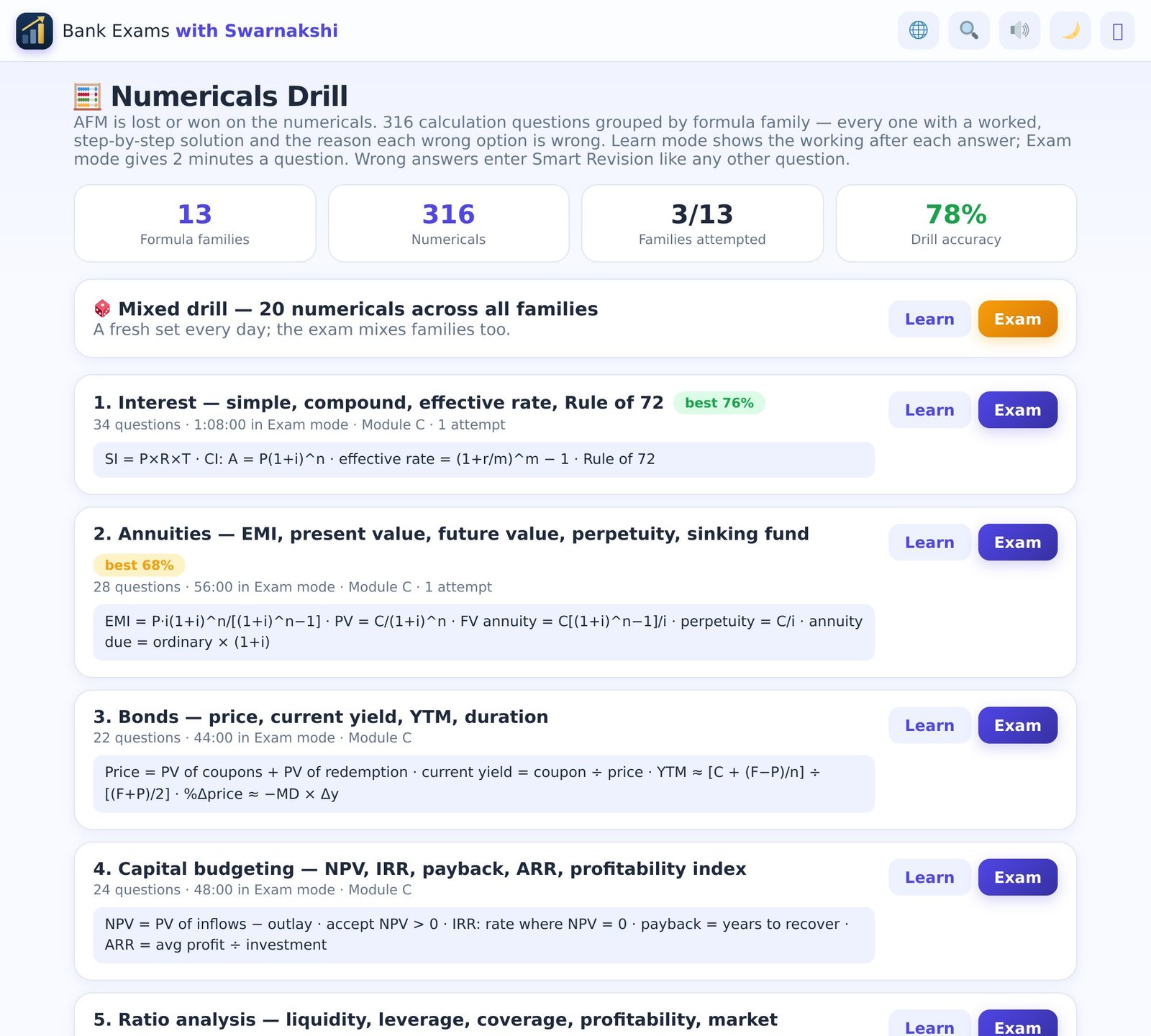
So the Mock Centre now has a Numericals Drill: 316 AFM calculation questions in 13 formula families, every one with a step-by-step worked solution and a one-line reason for each wrong option (because in numericals the wrong options are the common slips — the forgotten scrap value, the un-annualised rate, the sign the wrong way round). Learn mode shows the working after each answer; Exam mode gives two minutes a question; wrong answers enter Smart Revision like any other question.
The map: every AFM calculation belongs to one of these
Print this table. If you can do one question from each row without looking anything up, you can do the AFM numericals.
#
Family
The formulas
Qs
1
Interest simple, compound, effective rate, Rule of 72
SI = P×R×T · CI: A = P(1+i)^n · effective rate = (1+r/m)^m − 1 · Rule of 72
34
2
Annuities EMI, present value, future value, perpetuity, sinking fund
Home → Numericals Drill. Each family shows its question count, the formulas, and your best score. The mixed drill draws 20 questions across families — a fresh set every day.
Pick a family, start in Learn mode. Answer, press Save & Check, and the full working appears — formula, substitution, arithmetic, answer — plus why each other option is wrong.
Switch to Exam mode when the family feels easy. Two minutes a question, timer, palette, no help until you submit. Then review every question, including the ones you got right.
Let Smart Revision do the rest. Every numerical you get wrong comes back after 2, 7 and 15 days. A formula you have applied correctly three times, weeks apart, is a formula you will not lose in the hall.
Do the mixed drill before the paper. The exam mixes families; so does the mixed set. Twenty questions, 40 minutes, once a day in the last fortnight.
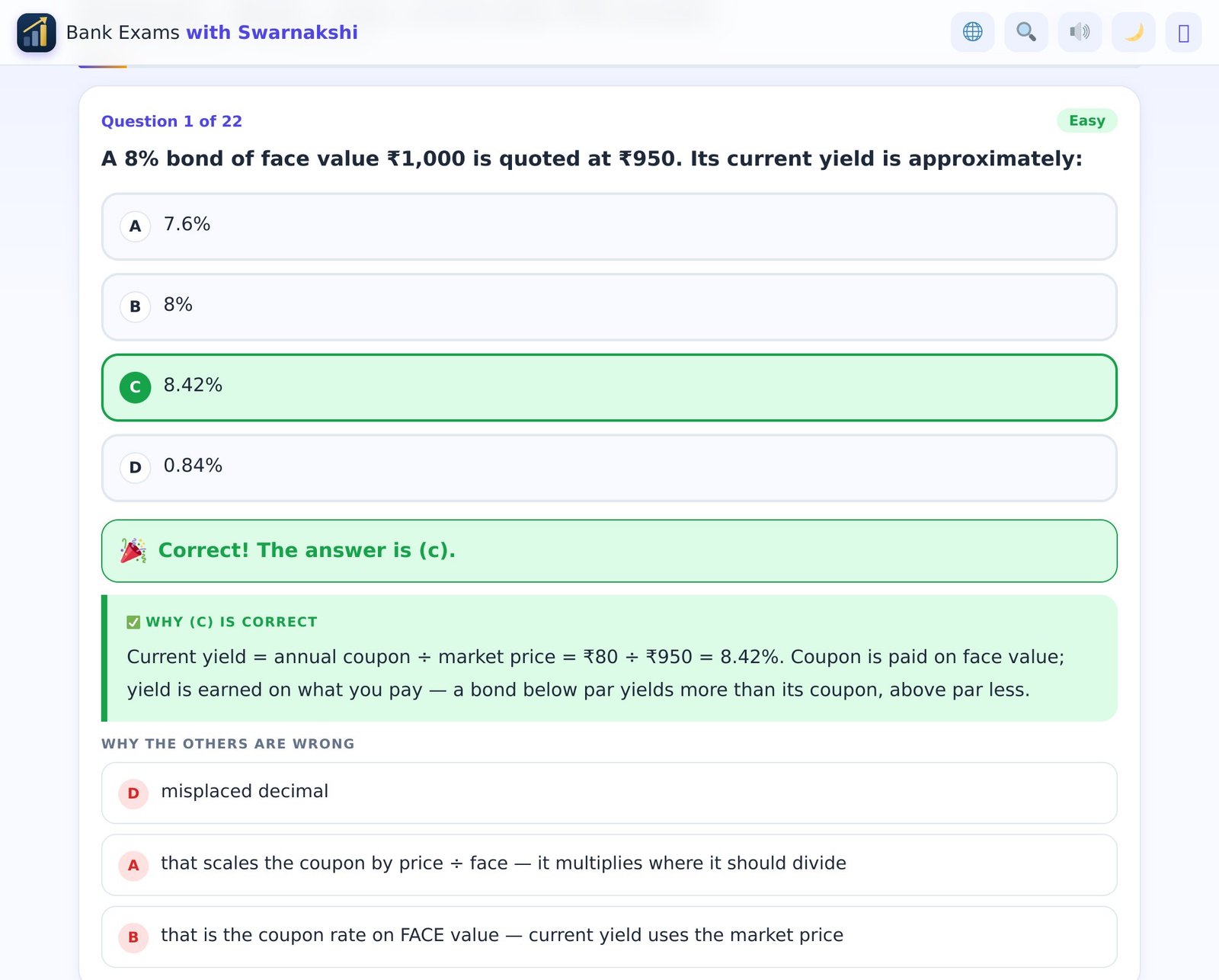
Learn mode: the working, then the slips behind each wrong option — in numericals, that is where the marks go.
Try ten now — one from each of ten families
🧮 Free drill · 10 numericals, one from each of ten families
Work each one on paper first, then click an option. The working opens immediately, with the reason each wrong option is wrong. Budget about two minutes a question.
Question 1 of 10 · Interest
₹1,00,000 is invested at 8% per annum compounded annually. The maturity value after 3 years is closest to:
(a) that is simple interest — compound interest earns interest on interest
(b) that is the interest earned, not the maturity value
(d) that compounds for 2 years only
Question 2 of 10 · Annuities
A loan of ₹5,00,000 at 12% per annum (monthly rests) is repayable in 24 equal monthly instalments. The EMI is closest to:
Working. Monthly rate i = 12% ÷ 12 = 1%; n = 24. EMI = P × i × (1+i)^n ÷ [(1+i)^n − 1] = ₹5,00,000 × 0.01 × 1.2697 ÷ 0.2697 = ₹23,537. First month's interest = ₹5,000; the rest of the EMI reduces principal.
Why the others are wrong
(a) that is the first month's INTEREST only — an EMI also repays principal
(b) that is principal ÷ months — it ignores interest
(d) that charges FLAT interest on the full principal for the whole tenor — the reducing-balance EMI is lower
Question 3 of 10 · Bonds
A 8% bond of face value ₹1,000 is quoted at ₹950. Its current yield is approximately:
Working. Current yield = annual coupon ÷ market price = ₹80 ÷ ₹950 = 8.42%. Coupon is paid on face value; yield is earned on what you pay — a bond below par yields more than its coupon, above par less.
Why the others are wrong
(a) misplaced decimal
(b) that scales the coupon by price ÷ face — it multiplies where it should divide
(d) that is the coupon rate on FACE value — current yield uses the market price
Question 4 of 10 · Capital budgeting
A project costs ₹10,00,000 and yields ₹4,00,000 a year for 3 years. At a cost of capital of 10% (annuity factor 2.487), the NPV is closest to:
(a) 100% on everything applies to loss assets (or to the secured part only beyond 3 years)
(b) that provides on the secured portion only
(d) that applies 40% to the WHOLE outstanding — the unsecured part needs 100%
Answer all ten to see your score.
Five habits that turn numericals into free marks
Write the formula before the numbers. Half the errors in the drill come from substituting into a half-remembered formula. Writing "EMI = P·i(1+i)ⁿ ÷ [(1+i)ⁿ − 1]" takes four seconds and prevents the ₹20,833 trap.
Check the period. Monthly rate = annual ÷ 12; quarterly compounding = four periods; a 3-month forward premium is annualised by × 4. Most wrong options in the drill are period errors.
Know which way the sign goes. Price down when yields rise; adverse when actual cost is above standard; premium added, discount deducted; asset increase deducted in the cash-flow statement.
Sanity-check the size. An EMI must exceed principal ÷ months; a quick ratio must be below the current ratio; a doubtful-asset provision must be at least the unsecured portion. The drill's wrong options fail these checks.
Use the textbook's rate when the stem gives one. CRR is 3% today, but a sum that says "CRR 4.5%" wants 4.5%. Our September law update lists the figures that have moved.
🧮 Open the Numericals Drill.Log in to the Mock Centre → Home → Numericals Drill. The free demo opens the Module A families (depreciation, bank reconciliation); every Mock Centre pass includes all 13. Pair it with the 26 Numericals Masterclass Animated PPTs under Animated PPT Classes and the free AFM formula sheet.
Independent study aid — not affiliated with, endorsed by, or sponsored by IIBF. Exam pattern, question types and passing criteria are set by IIBF — confirm current rules at iibf.org.in. Figures in the drill are illustrative; where a regulatory rate has changed, the working says so.
Most popularAll-Access Bundle · ₹9,999All 25 books + the full Mock Centre · incl. GST