Leaving Work on Time: Why Finishing My Work Wasn’t Enough

On my very first day in banking, I was told something that has stayed with me.
“6 baje ghar jaane ka time nahi hota. You need to stay late.”
Day one. Before anyone had seen how I worked, staying late was already an expectation.
It didn’t make sense to me then. It never will.
I could understand being asked to complete something urgent. I could understand a colleague needing help or a situation that genuinely required us to stay. But a general instruction that six o’clock was not the time to go home? What exactly was I supposed to be staying for?
I would hear different versions of that sentence through the years.
Manager after manager. Branch after branch. The place changed, the people changed and the work changed. The expectation of staying late followed me everywhere.
After a while, I could no longer put it down to one difficult manager. Why did this keep happening wherever I went?
One evening in Patna captures the problem particularly well.
I had finished my work. Apparently, that wasn’t enough.
One of my postings was at a prominent, busy bank branch in Patna, which also happens to be my hometown.
Staying late there felt like an unwritten rule. There was this underlying expectation: you are in this branch, so how can you even think of leaving on time?
On one occasion, after finishing my work, I asked the branch head if I could leave.
Yes, asked. Why a grown adult needed permission to leave after completing the working day is a question I will return to in another blog.
The conversation, as I remember it, went along these lines.
“Did you finish the work?”
I said yes and indicated that I would take his leave.
But a colleague in the loan department was still working. Why didn’t I help her finish, he suggested, so that we could leave together?
“We are a team, na?”
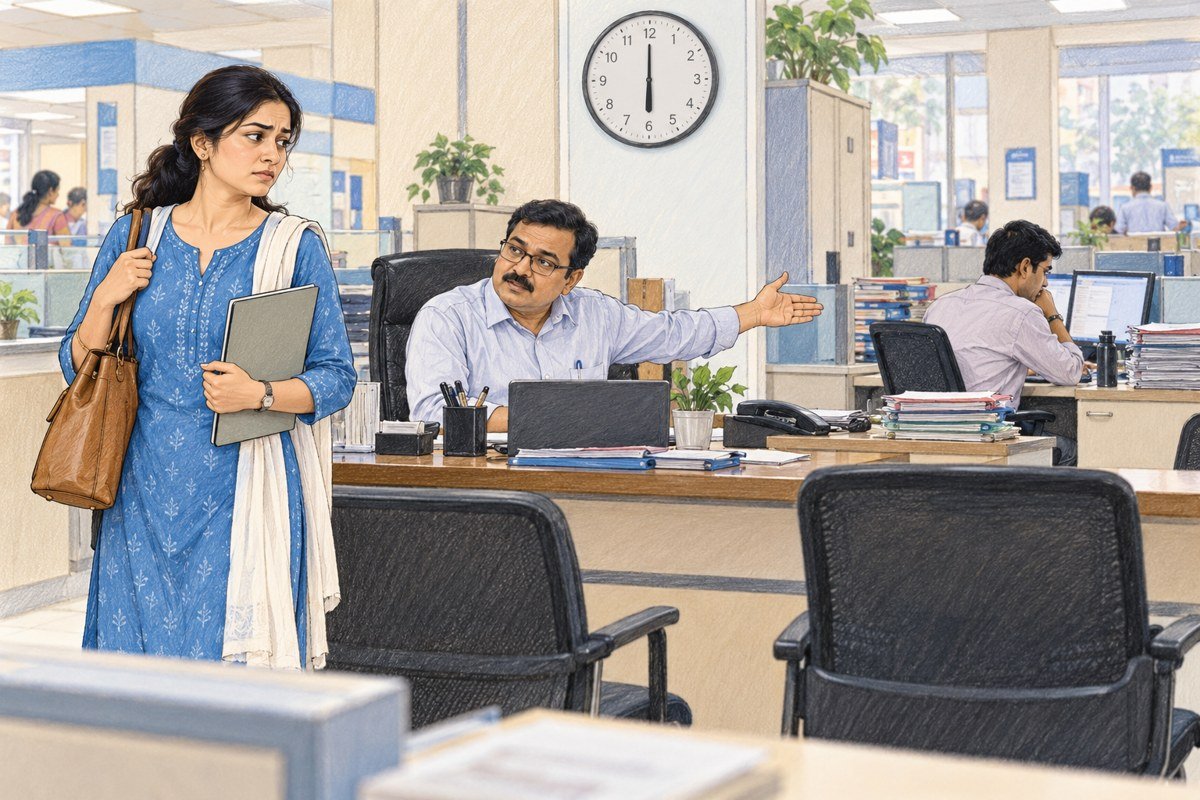
Teamwork. Of course. The word had arrived just in time to extend my day.
Because from what I had seen through the day, our use of time had been very different. I had been working relentlessly in a busy branch. She had taken roughly an hour for lunch instead of thirty minutes and spent time in extended chats with customers.
While I was dealing with my own hectic workload, I did not remember her coming over to ask whether I needed help.
But once I had finished, my remaining time was suddenly available for her work.
My immediate thought was: sorry, main Gopi bahu nahi hoon from Saath Nibhaana Saathiya. I was not volunteering to be the endlessly accommodating person everyone could take for granted.
I can laugh about the Gopi bahu comparison now. At the time, I was annoyed. I had worked through the day and finished my responsibilities. Why did that make my evening available for someone else’s work?
When does teamwork become a penalty for working efficiently?
Helping a colleague through an unusually difficult day is something I can understand. A colleague may have a more complex workload or an unexpected problem. Different finishing times alone tell us very little.
But that was precisely my objection: nobody seemed interested in understanding why we were finishing at different times.
Where had the day gone? Who had been carrying what? Was help needed because the workload was unreasonable or because time had been used differently?
Instead, the fact that one person was still sitting there appeared to be enough reason for another person to stay.
I wanted a team that noticed when I needed help too. That evening, “we are a team” seemed to apply only when I was ready to leave.
I do not think teamwork should require the same person to keep supplying the flexibility.
Some did the work. Others made sure the boss was watching.
There were two employees in that Patna branch who, in my view, had mastered a skill I had not: making sure their working day had an audience.
They were everywhere. Walking from one end of the branch to the other, entering the branch head’s cabin with every small update and emerging for another round of visible activity.
Meanwhile, some of us were at our desks, handling customers with genuine problems and work that required concentration. The kind where repeatedly getting up meant repeatedly losing your train of thought.
Our work required us to sit down. Their version of being busy seemed to require a lot of walking around.
I remember watching familiar customers being taken into the cabin for long conversations, even when the actual banking requirement seemed small. An interaction that could have taken a few minutes would stretch on, with plenty of conversation around it.
From where I sat, it looked quite convenient. The customer received leisurely attention and the employee appeared deeply involved. Outside the cabin, the less sociable work still needed doing.
And every morning, there were the enquiries about the family.
How are you, sir? How is madam? How are the children?
By itself, a friendly greeting would never have bothered me. What frustrated me was watching all this personal attention and visible movement sit alongside work that still needed someone’s time and brain.
I sometimes felt that the branch head was getting a more detailed account of their activity than an actual account of what had been accomplished.
Some of us were trying to clear the work. They seemed particularly good at making sure nobody missed how busy they were.
You may already be thinking of someone in your own office. The person who makes three trips to the manager’s cabin to announce progress on a task while someone else quietly finishes theirs.
What bothered me was how easily the quieter person could disappear from the picture. Sitting at your desk and concentrating is not especially theatrical. There is no entrance, no audience and no running commentary.

Later, when I read about passive “face time,” those scenes came back to me.
In a 2010 paper, Kimberly Elsbach, Dan Cable and Jeffrey Sherman examined how simply being observed at work can shape perceptions. Being seen during normal hours could lead observers to infer dependability. Being seen outside normal hours could lead them to infer commitment, with judgments arising spontaneously. [1]
The study was about passive visibility. It did not test cabin visits, customer conversations or the behaviour of my colleagues. But it helped me recognise how readily what a manager sees can become the basis for what a manager believes.
And it made me think about how that advantage might grow when an employee actively makes sure they are seen.
If visible activity earns recognition during the day and visible presence earns recognition in the evening, where does that leave the person who works steadily, finishes responsibly and wants to go home?
Apparently, back at the cabin door, explaining themselves.
Another branch. Another first day. The same expectation.
There was another posting, this time somewhere unfamiliar to me.
I had been transferred abruptly. To me, that transfer felt like management’s response to my questions. I will share the circumstances in another article because there is more to that story.
Here, I want to talk about the first evening there.
I was far from home, alone and unfamiliar with the place. On my first day there, I wanted to get home before it became dark.
I thought that was a reasonable concern to explain.
The manager still had a problem with it. His response was essentially: so what? You could not leave this early just because it was your first day.

What stayed with me was how little my circumstances seemed to matter. I was trying to navigate a new place, but the conversation had already become about whether I was leaving too early.
A new branch and I was already having the same conversation.
That is why I struggle when late sitting is presented as a straightforward matter of dedication. What does staying later on that particular first day reveal about my ability, my integrity or the work I would eventually do there?
And why was my concern about getting home before dark so easy to brush aside?
How everyone staying becomes the reason everyone must stay
After seeing this expectation across postings, I began to question another familiar defence: “This is how things work here.”
That sentence can make a practice sound settled without explaining why it exists.
A new employee sees seniors staying. Colleagues stay too. Leaving requires a conversation. Perhaps there is a comment, a look or a reminder about commitment.
Over time, people may learn that staying is the easier option.
I think this is one way the habit keeps going. Some people genuinely have pending work. Others may prefer a later schedule. Some may simply want to avoid the conversation.
From across the room, they all look like a team that willingly stays late.
But a room full of people is not evidence that everyone agrees with the arrangement.
Why the question itself can feel risky
Amy Edmondson’s 1999 research on 51 work teams examined psychological safety: whether team members believed they could take interpersonal risks safely. The study found an association between psychological safety and team learning behaviour. [2]
It was not a study of leaving times. The connection I draw is about what happens when an employee questions an established practice.
Why are we staying? What is pending? Could this have been planned earlier?
These are useful questions. Yet I know from my own experience that asking questions can feel very different from being invited to ask them.
My understanding of that abrupt transfer made the stakes feel particularly real to me. A person who believes that questioning management has already cost them something does not enter the next conversation feeling entirely free.
That is why I would hesitate to interpret silence as acceptance.
Sometimes, the person sitting quietly has simply decided that another argument will cost more than another hour.
If the work genuinely needs extra time, let’s examine the work
None of these experiences means that every late evening is unnecessary or that everyone who stays is pretending to work.
Banking involves responsibilities that cannot always be put down at a convenient moment. So do many other professions. An urgent issue or an unexpectedly difficult day can require colleagues to support one another.
What I question is the point at which this stops being an exception and becomes the default expectation.
If a branch regularly cannot finish within the available time, I want to understand why.
Are there too few people? Slow systems? Delayed approvals? Repeated reporting? Work being assigned near closing time? An uneven distribution of tasks?
The Patna conversation could have been an opportunity to examine workload and how help was shared throughout the day.
Instead, the immediate solution was for the person ready to leave to remain.
If the work somehow gets done every evening because people stay back, it becomes easier to avoid asking why it could not be done during the day.
Another hour is not automatically another hour’s worth of output
There is also a practical question beneath all this: how much useful work does extending the day actually produce?
Economist John Pencavel studied historical munitions-worker data and found that the relationship between hours and output was nonlinear. Beyond a threshold, output increased at a decreasing rate as hours rose. [3]
That setting is very different from a modern bank. The study does not give us a universal cut-off after which office work becomes unproductive.
But it does challenge the assumption that adding hours will keep delivering proportional gains.
When I think back to that busy Patna branch, I would have wanted someone to look at the whole working day. What was completed? Where were the delays? Was work allocated fairly? When did people need support?
Those questions would have told us much more than who happened to be sitting there last.
What would I change?
After these experiences, I have little patience for advice that amounts to asking employees to adjust a little more.
I would start with how the work is managed.
Make teamwork something people experience throughout the day
If colleagues are expected to help one another, make sure help goes both ways and reaches the people who need it.
Notice the person struggling at noon. Check who is overloaded before the evening arrives. Don’t wait until someone has finished their own responsibilities to discover that the team needs them.
Find out why late sitting keeps happening
Look at staffing, systems, approvals, meetings and the distribution of work. Where extended coverage is genuinely required, plan it through clear schedules and applicable policies.
“We always stay late here” should begin an investigation, not end the conversation.
Assess the whole contribution
Accuracy, reliability, customer service, judgment and support for colleagues all matter. The complexity of someone’s work matters too.
A departure time tells you very little about any of these.
Make room for the employee’s circumstances
A person starting in an unfamiliar place should be able to raise a practical concern and receive a thoughtful response.
Someone who has completed their work should be able to discuss leaving without being made to feel disloyal.
Managers do not have to share every personal priority to recognise that employees have lives they need to organise.
And what can employees do?
I remember what it feels like to ask permission to leave, so I am careful with “just set boundaries” advice. Employees have different levels of security, support and freedom to disagree.
Where feasible, give a clear update on completed work and handovers. If more work arrives, ask which priority should move. A factual record of recurring tasks and delays can make workload discussions more specific.
But an employee cannot communicate their way out of every unreasonable expectation. The organisation still has to take responsibility.
I understand it better now. It still doesn’t make sense.
When I put these experiences together, the pattern becomes clearer to me.
I think of my first day, when staying late was expected before anyone knew how I worked. I think of Patna, where finishing my tasks was not enough. And I think of explaining that I needed to get home before dark, only to have that concern brushed aside.
The research helped me understand how visible effort can influence judgment. My own experience showed me how difficult it can be to question an expectation once everyone treats it as normal.
It cannot tell me exactly what each manager thought. It has helped me ask better questions about the culture around those decisions.
What are we actually measuring when we praise someone for staying late? What are we overlooking during the day? And why does leaving at an expected time so often require a defence?
I still believe commitment shows in how responsibly we work, how honestly we handle problems and how reliably we support one another.
There must be room in that understanding for a working day to end.
“6 baje ghar jaane ka time nahi hota.”
It didn’t make sense to me then. It never will.
Before questioning why an employee wants to leave, ask why the workplace keeps needing them to stay.
Has “we are a team” ever become the reason you were expected to stay after finishing your work? Share your experience in the comments without naming colleagues or sharing confidential information.
And share this with someone who has heard “Aaj jaldi?” after a full working day.
Research and further reading
- How passive ‘face time’ affects perceptions of employees: Evidence of spontaneous trait inference
Elsbach, Cable & Sherman (2010), Human Relations - Psychological Safety and Learning Behavior in Work Teams
Edmondson (1999), Administrative Science Quarterly; Harvard repository abstract - The Productivity of Working Hours
Pencavel, published online 2014; journal issue 2015, The Economic Journal
Swarnakshi Jha
I’m a former banker and the founder of lifeasithink_ and SJA Learning. I write about workplace culture, the experiences that stayed with me and the questions I believe we should be able to ask at work.